

How knowing when your body gets the most restorative sleep can change how you rest and recover after birth.

I want you to know how learning about sleep cycles can genuinely help your postpartum experience.
We actually get the most deep sleep early in the night — and that deep sleep is the most restorative kind.
So when we think about how broken our sleep can be during postpartum, it makes sense that we’d want to maximize those early, restorative stages as much as possible.
You’ve probably heard the term “sleep cycle”, but let’s break down what that really means — and how it can work in your favour.
What Is a Sleep Cycle?
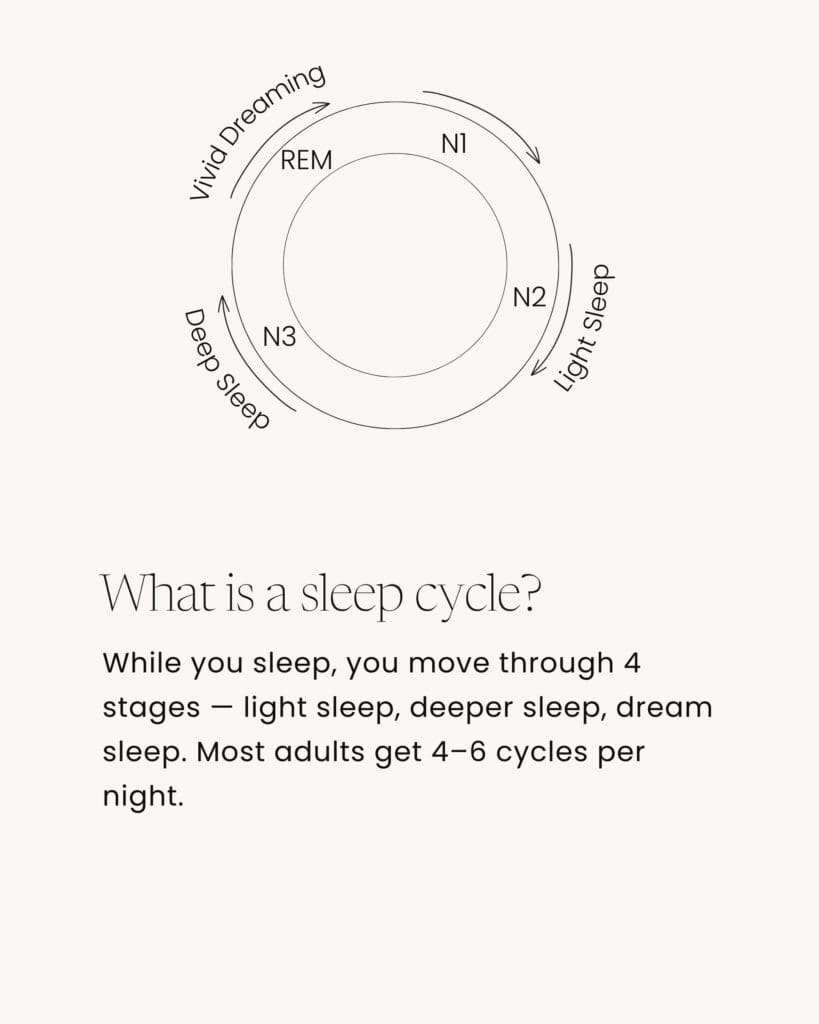
While you sleep, you move through multiple cycles each night, and each cycle includes four stages.
- A full cycle lasts roughly 90–110 minutes.
- Most adults experience 4–6 cycles per night.
- These cycles are made up of two main phases:
- NREM (Non-Rapid Eye Movement) — Stages 1–3
- REM (Rapid Eye Movement) — Stage 4, where dreaming happens
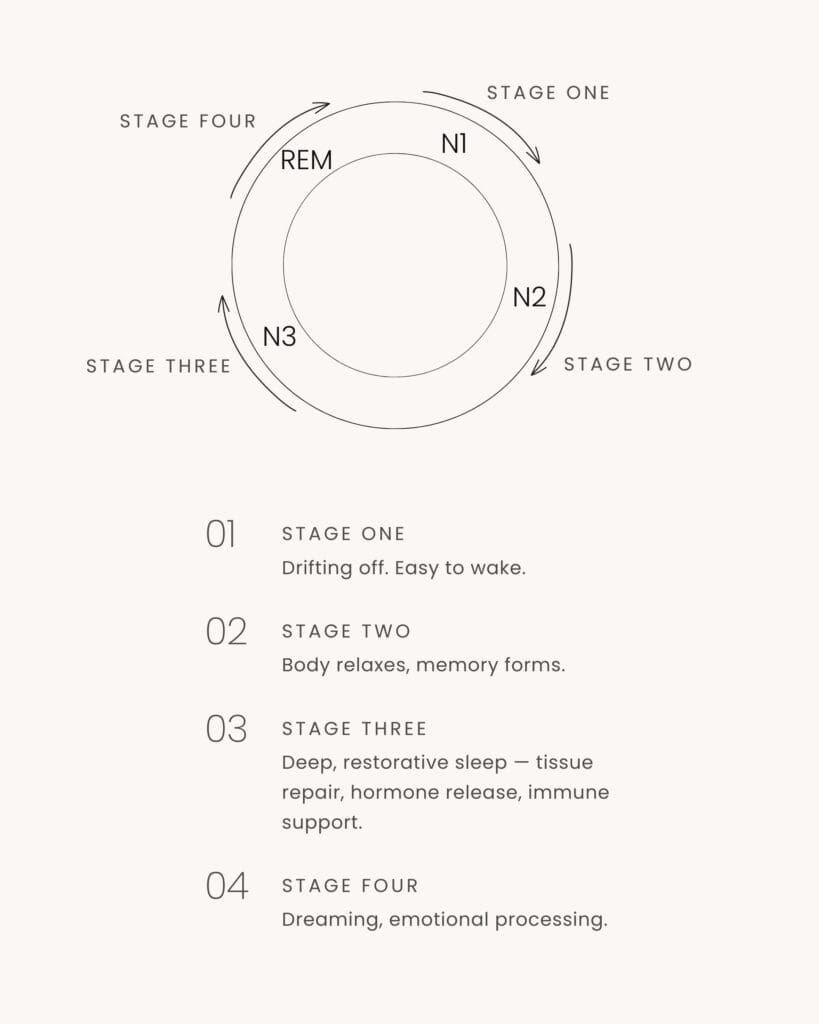
The Stages of Sleep
Stage 1 (N1) – Light sleep
You’re drifting off; heart rate, breathing, and brain waves begin to slow. This stage lasts only a few minutes and is easy to wake from.
Stage 2 (N2) – Light but deeper sleep
Your muscles relax, body temperature drops, and breathing slows. This stage supports memory and makes up most of your sleep time.
Stage 3 (N3) – Deep sleep (slow-wave sleep)
This is the most restorative stage.
Your brain waves slow right down, growth hormone is released, tissues repair, and your immune system strengthens.
If you wake here, you’ll feel groggy or disoriented — that’s how deeply your body is resting.
REM Sleep – Dream sleep
Your brain becomes active, muscles are still, and this is when most dreaming occurs.
REM sleep supports emotional balance and memory processing.
Why This Matters in Motherhood
Most of your deep NREM sleep happens in the first half of the night — especially in the first one or two cycles.
As the night goes on, deep sleep shortens and REM sleep lengthens. So when your baby wakes you frequently, those early interruptions cut into your most restorative sleep.
And no, going to bed later doesn’t “shift” your deep sleep later — your body is wired to prioritise deep sleep early in the night.
Dr. Walker’s research shows that our circadian rhythm (the 24-hour biological clock that controls sleep timing, hormone release, and temperature) primes us for deep sleep earlier in the evening.
As the night goes on, the body shifts toward REM sleep, which is lighter and less restorative for the body — though still vital for emotion processing.
So when we stay up late or have inconsistent sleep times, we’re not just losing hours; we’re disrupting when our body is programmed to heal.
What I’ve Learned Personally
You can track this yourself on most smartwatches — I’ve tested it many times.
When I go to bed at 7:30 pm, I get around an hour of deep sleep. When I stay up until 10 pm, I average just 35 minutes.
That small difference might not sound huge, but it adds up — especially if you’re waking multiple times through the night for feeds.
For us mothers, going to bed earlier means capturing those early cycles when our bodies are most primed to repair and restore.
Practical Tips
- Protect your first sleep block.
If possible, take shifts with your partner or support person so you can get that uninterrupted stretch early in the night. - Get to bed earlier.
I know how tempting it is to stay up once the baby’s finally asleep — that quiet time feels sacred.
But from experience, that “just one more episode” moment usually turns into a very tired, frustrated mum at 4 am. - Keeping a consistent bedtime (even within a 30-minute window) helps:
- Stabilise your circadian rhythm, so your body knows when to wind down.
- Regulate hormones like cortisol, melatonin, and prolactin — all crucial for stress, mood, and milk production.
- Reduce emotional volatility — Walker’s studies show inconsistent bedtimes lead to higher amygdala reactivity (that “short fuse” feeling we all know).
- Improve energy and alertness, even if your total sleep hours are fragmented.
Try it and notice the difference — in your mood, energy, patience, and even appetite.
When I started prioritising my deep sleep, I felt calmer, happier, and more present.
References
- Walker, M. P. (2017). Why We Sleep: Unlocking the Power of Sleep and Dreams. Scribner.
- Walker, M. P. (2019). Sleep Is Your Superpower. TED Talk.
- National Sleep Foundation. Stages of Sleep. sleepfoundation.org
- Mander, B. A., Winer, J. R., & Walker, M. P. (2017). Sleep and Human Aging. Neuron, 94(1), 19–36.
- Hirshkowitz, M. et al. (2015). Sleep Time Duration Recommendations. Sleep Health, 1(1), 40–43.








Comments +