
By Shanna Harding, Food Scientist and Certified Postpartum Doula, Resting Rituals
I’ve lost count of the number of times I’ve fed my baby in the car.
My toddler climbs into the front seat and pretends to drive. I sit in the passenger seat, baby latched, watching people walk past with their shopping. There’s usually a perfectly good cafe twenty metres away. Somewhere with a comfortable chair, a cold drink, air conditioning. And I’m in the car.
For the longest time I didn’t question it. Then recently I watched a mother breastfeeding in public, completely at ease, and found myself in awe of her. I started asking why I couldn’t imagine ever feeling that carefree. I remembered studying the history of breastfeeding in my doula training, so I went back to have a read.
The room scan
Here’s what happens before I feed in public. I scan the room. I check who’s around, guess their ages, and quietly estimate how welcoming they’ll be. Then I make a decision based on other people’s comfort, not mine.
If my baby is genuinely hungry, all of that evaporates and he comes first, every time. But if I can push the feed back ten minutes to somewhere more private, I will. I’ve been taught not to make a scene. Don’t make people uncomfortable. Be a good girl. So I weigh up a stranger’s feelings before my own, while holding a hungry baby.
I don’t think I’m alone in this. And I’ve come to understand that this instinct isn’t really mine. I inherited it.
Breasts weren’t always like this
Part of the answer turned up while I was going through the modules of my doula certification. Breasts aren’t sexual organs. They’re not connected to reproduction at all. Biologically they’re a secondary sexual characteristic, in the same category as a man’s deep voice or his Adam’s apple. Nobody asks men to cover their Adam’s apples in public.
In the 1950s, two anthropologists studied over 190 cultures for their book Patterns of Sexual Behavior. Only 13 of those cultures treated breasts as sexual. Other cultures were just as likely to find wide hips or fleshy calves attractive. There is nothing inherently sexual about breasts. We made that up.
And we made it up recently.
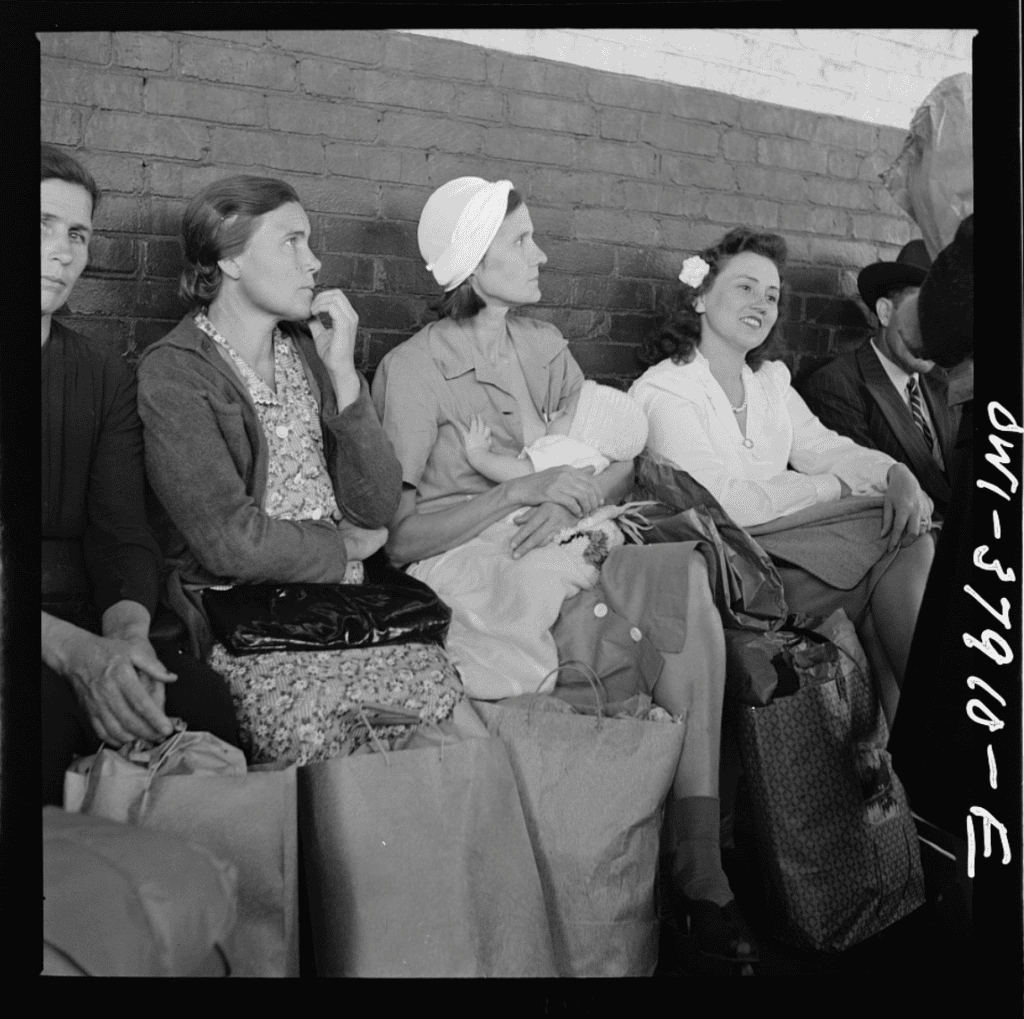
Chattanooga Greyhound terminal, 1943. Just a woman feeding her baby while she waits. Photographed by Esther Bubley.
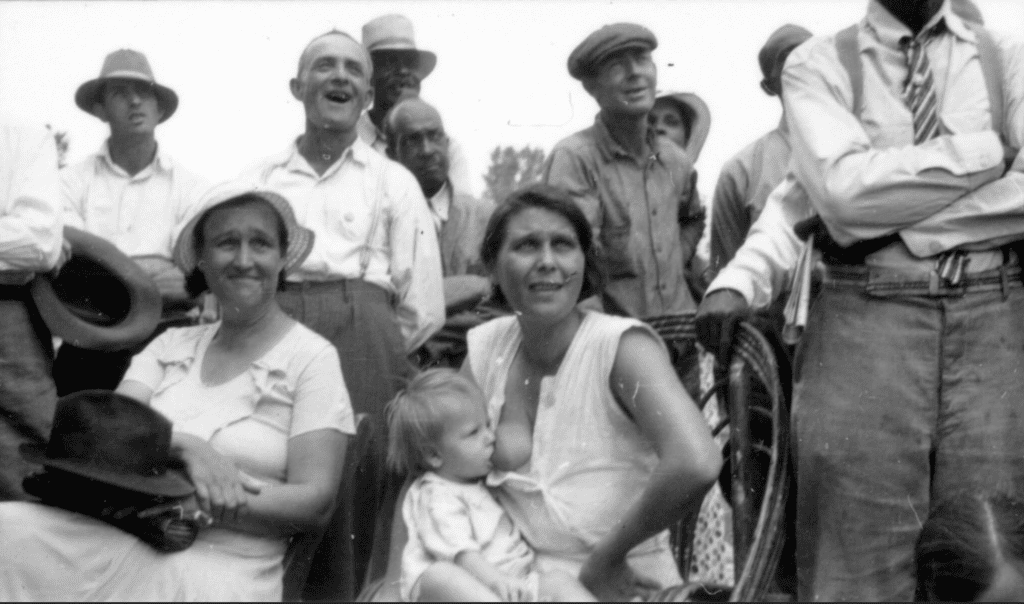
A woman breastfeeds her toddler at a public meeting, 1937. Nobody bats an eye. Photographed by Louise Boyle.
There are photographs from the 1930s and 40s, in deeply conservative decades, of women breastfeeding at outdoor meetings and bus terminals in front of men in suits and hats. Nobody is staring. Nobody is reaching for a cover. It’s completely unremarkable, because at the time, it was.
Then breasts became sexualised, and the historical record shows exactly what happened next. Public breastfeeding became taboo. Women felt watched. So they either breastfed less, or they stayed home to keep feeding.
Or, I suppose, they sat in the car.
I’m not describing a personality quirk when I talk about the room scan. I’m describing a documented historical shift, playing out in my body, in a Coles car park, in 2026.
I’m not a natural breastfeeder
I want to be honest about something else.
I don’t call myself a natural breastfeeder. I see other mums feed so effortlessly. Relaxed, chatting, baby settled, the two of them completely in sync. Then there’s me, where every feed can feel like a struggle, a fight, one uncomfortable position after another, trying to read cues through a fog of tiredness and feeling like I’m failing when I miss one.
For a long time my question was, what am I missing? What do those mums have that I don’t?
I’m starting to ask a different question. What am I listening to? Because some of what makes feeding hard for me isn’t happening between me and my baby. It’s the vigilance. The scanning. The part of my brain that’s monitoring the room instead of my child. Feeding while braced is not the same as feeding while relaxed, and no amount of technique fixes a nervous system that’s on watch.
And maybe those effortless mums aren’t effortless at all. Maybe some of them are running the same calculations and just hiding it better. I genuinely don’t know. But I suspect the gap between us is smaller than it looks from the outside.
What would feeding feel like without the inheritance?
This is the question I keep sitting with. If I’d grown up somewhere breasts were simply how babies eat, would I feed differently? Would I choose the comfortable chair? Would my shoulders drop?
I can’t unlearn forty years of conditioning. The room scan will probably fire next time too. But there’s real relief in knowing where it comes from. It’s not a flaw in me. It’s not evidence that I’m doing this wrong. It’s history, sitting in my shoulders, and naming it loosens its grip a little.
So if you scan the room before you feed, if you’ve ever fed in a car park or a parents room you didn’t want to be in, if you’ve wondered why something so natural feels so complicated, it isn’t you. You’re feeding a baby inside a culture that spent the last century making that harder, and you’re doing it anyway.




Comments +